9.1. Overview
Energy equity has several different dimensions, and BCAs can address only some of them. This chapter describes the limitations of BCAs in informing energy equity decisions and provides a conceptual framework for how to combine BCAs with distributional equity analyses (DEAs) to fully assess equity in DER investment decisions.
Energy equity is a complex and evolving topic. More detailed guidance on these issues is beyond the scope of this MTR handbook and warrants further consideration and development.
9.2. Definitions
9.2.1. Energy Equity
There is no standard definition of “energy equity” in the electric and gas utility industries. Some organizations define “energy equity” and “energy justice” as the same thing. Others view them as separate, with energy justice encompassing, among other things, the remediation of historical injustices in the energy system. For the purposes of this chapter, the following definition from the Pacific Northwest National Laboratory is helpful:
An equitable energy system is one where the economic, health, and social benefits of participation extend to all levels of society, regardless of ability, race, or socioeconomic status. Achieving energy equity requires intentionally designing systems, technology, procedures, and policies that lead to the fair and just distribution of benefits in the energy system (see PNNL Energy Equity).
9.2.2. Dimensions of Equity
Energy equity has three different inter-related dimensions—structural, procedural, and distributional—as shown in Figure 40. Ensuring equitable DER programs and policies will require careful consideration of all three dimensions of equity. Many jurisdictions have identified a broad range of structural and procedural metrics to help achieve their energy equity goals (LBNL 2021 Equity). Some have also identified certain distributional metrics, such as reducing energy burden and increasing participation in utility and other publicly funded energy programs. BCAs, however, are not designed to address procedural or structural equity. And the extent to which BCAs currently address distributional equity is fairly limited, as described below.21
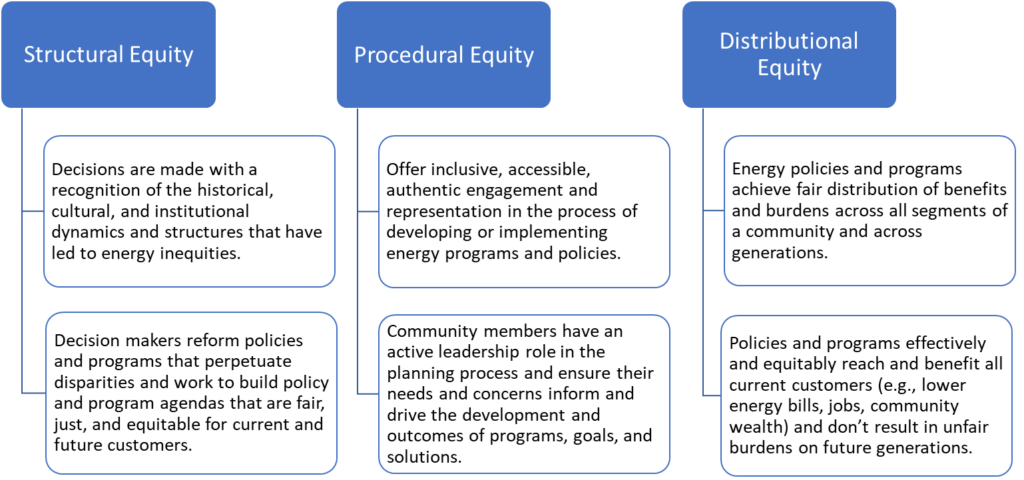 Figure 40. Dimensions of Energy Equity
Source: Adapted from the American Council for an Energy Efficient Economy (see ACEEE Energy Equity).
The equity dimensions above largely address intra-generational impacts (e.g., ensuring all current customers benefit from DER investments). However, one component of distributional equity is intergenerational equity22 which generally refers to meeting the needs of current customers without compromising the ability of meeting the needs of future customers. Intergenerational equity is discussed further in Section 9.3.4.
9.2.3. Target Populations
Jurisdictions are increasingly identifying specific populations to ensure that there is an equitable allocation of costs and benefits in energy investment decisions across all customers. These specific populations can include environmental justice communities, disadvantaged communities, low-income households, marginalized communities, limited English-proficiency households, and the businesses and organizations that serve these communities. For the purposes of this report, these people and communities that are the subject of energy equity concerns are referred to collectively as “target populations.”
Table 80 provides several examples of target populations used by jurisdictions for equity purposes. It illustrates the variation in how these populations have been identified to date.
Table 80. Target population examples used by some jurisdictions
| Targeted Population |
Definition |
| Underserved Populations |
People who have limited or a decreased level of service or access to energy system services |
| Marginalized Populations |
People excluded from participating in decision-making and those who lack access to basic economic, political, cultural, and social activities |
| Vulnerable Populations |
Those who are economically disadvantaged, racial and ethnic minorities, the elderly, rural residents, linguistically isolated, those with inadequate education, and those with other socioeconomic challenges |
| Highly Impacted Populations |
Communities living in geographic locations characterized by energy inequity and facing economic or historical barriers to participation in energy decisions and solutions |
| Disadvantaged Populations |
Those who most suffer from economic, health, and environmental burdens |
| Over-Burdened Populations |
Minority, low-income, tribal or indigenous populations, or geographic locations that potentially experience disproportionate environmental harms and risks |
| Fenceline Populations |
Communities living in closest proximity to dangerous facilities (within one-tenth of a facility’s vulnerability zone), also referred to as “frontline” populations |
| Low- to Moderate-Income People |
People who make less than a certain income threshold relative to the area median income |
Source: Adapted from PNNL Energy Equity.
This chapter does not provide guidance on how a jurisdiction should define their target population, as such definitions and categories can vary from state to state. Instead, this chapter focuses on key considerations in accounting for the distribution of DER costs and benefits that accrue to target populations compared to general customers.
9.3. Methods for Assessing Energy Equity
9.3.1. Benefit-Cost Analysis
Regulators, utilities, and others have traditionally tried to address some aspects of energy equity by providing energy efficiency programs to low-income customers, and by accounting for the specific costs and benefits of those programs in a BCA. Sometimes these costs and benefits are accounted for in the low-income host customer impacts, and in other cases they are accounted for by applying alternative benefit-cost ratio thresholds for low-income programs (see Chapter 6 for methods on quantifying host customer impacts). Further, some jurisdictions account for societal impacts of DER investments that recognize certain benefits that are important to achieving equity goals, e.g., reduced air emissions, improved public health, job creation, etc. (see Chapter 7 for methods on quantifying societal impacts).
However, accounting for low-income and societal impacts in a BCA does not provide information on how the costs and benefits of DERs are distributed between target populations and other customers. This is the key aspect of customer equity that BCAs are not typically designed to address to date.
BCAs compare an investment’s benefits to its costs, “without any consideration of who pays the costs nor who receives the benefits.”
BCAs are not designed to assess distributional impacts between customers, i.e., the impacts that vary between different categories of customers. BCAs compare an investment’s benefits to its costs, “without any consideration of who pays the costs nor who receives the benefits” (NYU IPI, page 5). Instead, they are intended to address impacts on customers or society on average, i.e., in absolute terms as opposed to relative terms. Yet achieving equity requires consideration of the distributional impacts between customers. Achieving equity, by definition, requires comparing impacts on some groups of customers relative to other groups.
Many of the benefits of DERs, in terms of avoided costs, are shared across all customers. Similarly, the utility system costs of DER programs are typically passed on to all customers.23 Thus, the costs and benefits included in a BCA are typically a blend of impacts experienced by all customers, by society, by broad customer categories, or by host customers. Therefore, the bottom-line results of the BCA, in terms of net benefits or a benefit-cost ratio, cannot be broken out to indicate distributional effects across customers or on target populations.
The costs and benefits included in a BCA are typically a blend of impacts experienced by all customers, by society, by broad customer categories, or by host customers. Therefore, the bottom-line results of the BCA, in terms of net benefits or a benefit-cost ratio, cannot be broken out to indicate distributional effects across customers or on target populations.
This limitation is true even for a DER program that is specifically designed to serve a target population. For example, a BCA test for a low- to moderate-income (LMI) energy efficiency program that includes the LMI host customer non-energy benefits also includes the avoided cost benefits that are experienced by all customer sectors. And the avoided costs used in most BCAs are the utility system avoided costs, not the LMI host customer bill savings. Further, the costs of LMI energy efficiency programs are typically passed on to all other customers, and many LMI energy efficiency programs do not require the host customers themselves to pay any portion of the energy efficiency measure costs. Thus, a BCA for an LMI energy efficiency program (or any program for a target population) includes a blend of costs and benefits experienced by the host customers and other customers, and it is not possible to break out any distributional effects of those programs.
The one exception to this limitation of BCAs is the Participant Cost Test, which measures the direct costs and benefits to DER host customers. In this case, there is no blending of impacts across all customers or multiple customer types: The Participant Cost Test includes the costs, benefits, and non-energy impacts to participants only. Thus, the Participant Cost Test can be used to indicate how DERs will affect host customers. However, even this would be a very limited indication of equity. It only shows whether DER host customers are better off with the DER. The Participant Cost Test provides no information regarding how DERs affect non-participants, nor does it provide any indication about impacts on target populations relative to other customers.24
9.3.2. Rate, Bill, and Participation Analyses
A better way to assess customer equity is through rate, bill, and participation analyses. These analyses provide information about the extent to which rates and bills might change for DER host customers relative to non-host customers. They also provide information about how many customers are host customers versus non-host customers. Because DER host customers typically experience greater benefits than non-host customers, customer participation rates provide very useful information about customer equity (see NSPM 2020 Appendix A).
Because DER host customers typically experience greater benefits than non-host customers, customer participation rates provide very useful information about customer equity.
Consistent with NSPM principles, it is important to keep rate, bill, and participation analyses separate from BCAs because they answer fundamentally different questions:
- BCAs typically address the question of which DERs will have net benefits across customers and perhaps society on average, and therefore might merit utility acquisition or support on behalf of all customers.
- Rate, bill, and participation analyses address the question of whether and how much will DERs increase or reduce rates for host customers and non-host customers. They also address the question of what portion of customers will be host customers and thereby experience greater benefits than non-host customers. This provides very useful information regarding equity between host and non-host customers.
However, rate, bill, and participation analyses do not address a key aspect of energy equity: They do not provide information on how the costs and benefits of DERs are distributed between target populations and other customers. Further, comprehensive rate, bill, and participation analyses have not been used by many jurisdictions to date, and therefore have not yet fulfilled their potential for providing even a limited equity analysis.
Table 81 presents a summary of how both BCAs and rate, bill, and participation analyses are limited in the way that they address distributional impacts on target populations.
Table 81. Limitations of BCAs and rate, bill, and participation analyses in addressing equity
| Type of Analysis |
Method |
Limitations |
| Benefit-Cost Analyses |
Account for host customer impacts in a BCA test |
- Results include a blend of costs and benefits across all customers and several customer types
- Does not distinguish between host customers in a target population versus other customers
|
| Account for societal impacts in a BCA test |
- Results include a blend of costs and benefits across all customers and several customer types
- Does not distinguish between societal impacts on average versus those that affect target populations
|
| Account for only participant (host customer) impacts in BCA, i.e., use Participant Cost Test |
- Does not provide information on non-participants
- Does not provide information on target populations
- Should not be used to inform utility investment decisions
|
| Rate, Bill, and Participation Analyses |
Review participation rates; assess associated rate and bill impacts on host and non-host customers to ensure they are not unduly high or inequitable |
- Does not provide information on non-participants
|
9.3.3. Distributional Equity Analysis
Distributional equity analyses can explicitly account for the difference in impacts between target populations and other customers.
Distributional equity analyses (DEAs) can be used to address the limitations of BCAs and rate, bill, and participation analyses in assessing energy equity. DEAs can explicitly account for the difference in impacts between target populations and other customers.
DEAs ideally should start with a conventional rate, bill, and participation analysis and expand on it as follows:
- Expand the rate, bill, and participation analysis to compare these impacts on target populations versus other customers.
- Add additional equity metrics such as energy burden, customer arrearages, etc.
- Assess the distribution of specific DER impacts between target populations and general customers. This might include, for example, an assessment of service reliability to target populations versus other customers, or of the public health impacts on target populations versus other customers.
Like BCAs, DEAs should be designed to address the policy goals of the jurisdiction. The definition of target populations, the choice of equity metrics, and the specific impacts to calculate distributional effects for, should all be based on how the jurisdiction wants to address equity.
BCAs and DEAs are complementary. They should be conducted in parallel, using consistent inputs and assumptions. The results of the two analyses, however, should be presented side-by-side for decision-making purposes.
BCAs and DEAs are complementary. They should be conducted in parallel, using consistent inputs and assumptions. The results of the two analyses, however, should be presented side-by-side for decision making purposes (see NYU IPI 2022). BCAs and DEAs use different metrics: BCAs present results in terms of net benefits or benefit-cost ratios for customers and perhaps society on average, while DEAs present results in terms of rate impacts, bill impacts, DER participation, energy burden, customer arrearages, reliability, resilience, public health, and other metrics as warranted. BCAs and DEAs also answer fundamentally different questions: BCAs answer the question of how DERs affect customers and perhaps society on average, while DEAs answer the question of how DERs affect target populations relative to other customers. If BCAs and DEAs are combined somehow, then it is very difficult to answer either of these questions.
Figure 41 provides a conceptual framework for how BCAs combined with DEAs can address energy equity issues and inform utility investment decisions. It also indicates how the procedural and structural dimensions of equity are not directly related to BCA practices.
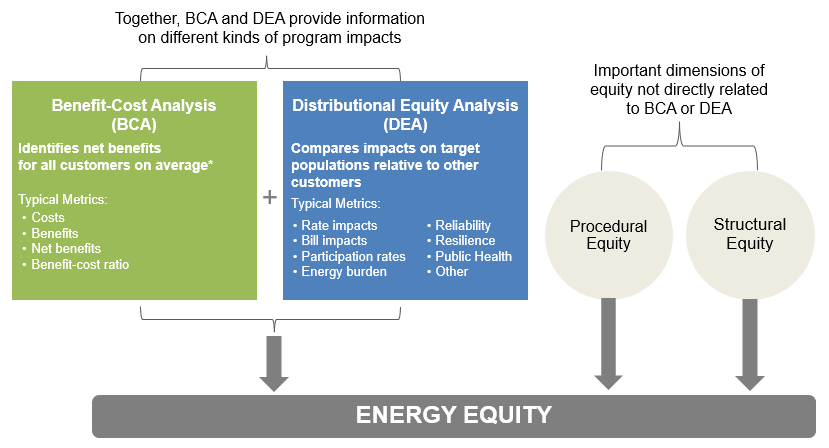 Figure 41. Energy equity and benefit-cost analysis
* Non-utility system impacts can be accounted for in BCAs if consistent with the jurisdiction’s policy goals, but inclusion of these impacts in BCA does not provide a measure of equity across target populations.
Table 82 presents a high-level comparison of BCAs, Rate, Bill, and Participation Analyses, and DEAs. It indicates how they serve different purposes, address different questions, and use different metrics to report the results.
Table 82. High-level comparison of BCAs, rate, bill, and participation analyses, and DEAs
| |
Benefit Cost Analysis |
|
Rate, Bill, Participation Analysis |
Distributional Equity Analysis |
| Purpose |
To identify which DERs utilities should invest in or otherwise support on behalf of customers on average |
|
To identify how DERs affect host versus non-host customers |
To identify how DERs affect target populations versus other customers |
| Questions Answered |
What are the costs and benefits of DERs across customers and perhaps society on average?
What are the costs and benefits of a DER program designed for target populations? |
|
What is the impact of DERs on host versus non-host customers? |
What is the impact of DERs on target populations versus other customers? |
| Example Metrics for Reporting Results |
Costs (PV$)
Benefits (PV$)
Net benefits (PV$)
Benefit-cost ratios |
|
Rate Impacts ($/kWh)
Bill Impacts ($/month)
Participation rates (% of eligible customers) |
Rate Impacts ($/kWh)
Bill Impacts ($/month)
Participation rates (% of eligible)
Additional Impacts on target population:
- Energy burden
- Reliability
- Resilience
- Public health
- Other
|
Although this conceptual framework may be new to electric and gas utility BCAs to date, distributional analyses are frequently conducted by federal agencies as part of regulatory BCA. Agencies like the EPA include distributional analyses as part of their broader regulatory impact analyses when proposing new regulations (see NCEE 2014, Chapter 10). Separately, the New York University Institute of Policy Integrity has developed guidance on the procedures and methodologies that the Office of Management and Budget (OMB) could apply to account for equity in the regulatory review process, with a focus on environmental injustice (see NYU IPI 2021; NYU IPI 2022).
9.3.4. BCA and Intergenerational Equity
As noted above, intergenerational equity is one aspect of distributional equity. Intergenerational equity addresses the concept of fairness among current and future customers regarding the costs and benefits of energy resources.
Intergenerational equity can be addressed, in part, by using a study period for the BCA that is long enough to capture the full lifetime costs and benefits of a DER (see NSPM 2020, Principle #5). In this way, the BCA accounts for the costs and benefits of all customers over the operating life of the DER.
However, it is common practice to apply a discount rate to the costs and benefits of a BCA, which places greater weight on the costs and benefits in the short term relative to the long term. As described in the NSPM:
The discount rate reflects a particular “time preference,” which is the relative importance of short- versus long-term impacts. A higher discount rate gives more weight to short-term benefits and costs relative to long-term benefits and costs, while a lower discount rate weighs short-term and long-term impacts more equally (see NSPM 2020, Appendix G, page G-1).
The choice of discount rate is a decision that should be informed by the jurisdiction’s applicable policy goals. Therefore, the regulatory perspective should be used to determine the appropriate discount rate (see NSPM 2020, Appendix G, page G-1).
If a jurisdiction has a policy goal to improve, or at least not worsen, intergenerational equity, then the regulators in that jurisdiction should lean towards applying a lower discount rate than they might otherwise apply. Intergenerational equity would be one of the many factors that regulators should use in determining a discount rate. (For a summary of the process that regulators should use, and the factors to consider, in determining a discount rate, see NSPM 2020, Appendix G, Section G.5.)
Further, there are some impacts of electricity and gas resources that have more long-term implications than others. GHG emissions, in particular, are likely to have greater impact over the long term than the short term. If a jurisdiction has a policy goal to address intergenerational equity with regard to climate impacts, then the choice of discount rate used to determine the benefits of reducing GHG emission will have important intergenerational equity implications.
9.3.5. Challenges and Additional Considerations
As stated above, this chapter represents a conceptual framework on how BCAs can be used to assess whether DERs can advance energy equity goals. More work remains to be done to develop specific methodologies and best practices for conducting and using DEAs in decision-making alongside BCAs. Additional research is necessary to answer at least the following questions:
- How should target populations be defined for the purpose of BCAs and DEAs?
- How should utilities collect more granular customer demographic data to identify target populations and create a baseline understanding of the target populations? Who should collect this data and who should it be shared with? How to protect customer privacy while collecting data on individual utility customers?
- How to construct a DEA? Which energy equity metrics should be used in conducting DEAs?
- How should DEA results be presented to decision-makers? For each DER program separately? For portfolios of programs for each DER type? For all DER programs combined?
- How should the BCA and DEA results be used together to make resource investment decisions? What should be done if a highly cost-effective DER is shown to be inequitable through DEA? What should be done if a DER is not cost-effective but offers important equity benefits?
- Should regulators establish thresholds, principles, parameters, or specific frameworks for comparing the monetary results of a BCA to the non-monetary results of a DEA?
- How can BCAs and DEAs be used to assess the relative magnitude of costs and benefits to target populations compared to other customers? In other words, how to account for the fact that one dollar to a customer in the target population might be worth a lot more than one dollar to other customers?
- How can jurisdictions use BCAs and DEAs to shed light on the cost of underinvesting in target populations?
- How should DEAs be used to influence DER program design?
9.4. Resources for Addressing Energy Equity
American Council for an Energy Efficient Economy (ACEEE Energy Equity). n.d. “Leading with Equity Initiative.” aceee.org website. https://www.aceee.org/energy-equity-initiative
Energy Equity Project. n.d. energyequityproject.com website. https://energyequityproject.com/
Illume Advising. 2021. The Energy Equity Playbook. https://illumeadvising.com/files/The.Energy.Equity.Playbook.pdf
Lawrence Berkeley National Laboratory. 2021. (LBNL 2021 Equity). Advancing Equity in Utility Regulation. Farley, Howat, Bosco, Thakar, Wise, Su. https://eta-publications.lbl.gov/sites/default/files/feur_12_-_advancing_equity_in_utility_regulation.pdf
National Center for Environmental Economics. 2014. (NCEE 2014). “Guidelines for Preparing Economic Analysis.” https://www.epa.gov/sites/default/files/2017-08/documents/ee-0568-50.pdf
New York University Institute for Policy Integrity. 2021. (NYU IPI 2021). Making Regulations Fair. Leinke, Paul, Sarinsky, Ünel, Varela. https://policyintegrity.org/files/publications/Making_Regulations_Fair_2021.08.31.pdf
New York University Institute for Policy Integrity. 2022. (NYU IPI 2022). “Distributional Consequences and Regulatory Analysis.” Revesz and Yi. https://policyintegrity.org/files/publications/Distributional_Consequences_and_Regulatory_Analysis.pdf
Pacific Northwest National Laboratory. (PNNL 2021). 2021. Review of Energy Equity Metrics. Tarekegne, Pennell, Preziuso, O’Neil. https://www.pnnl.gov/main/publications/external/technical_reports/PNNL-32179.pdf
Pacific Northwest. n.d. (PNNL Energy Equity). Pnnl.com website. https://www.pnnl.gov/projects/energy-equity#:~:text=What%20is%20energy%20equity%3F,energy%2Defficient%20housing%20and%20transportation
Regulatory Assistance Project. 2021. (RAP 2021). Smart Rate Design for Distributed Energy Resources. LeBel, Shipley, Linvill, Kadoch. Prepared for the Michigan Public Service Commission. https://www.michigan.gov/-/media/Project/Websites/mpsc/workgroups/der/rap-lebel-shipley-linvill-kadoch-smart-rate-design-distributed-energy-resources-2021-novem.pdf?rev=ea2732ce96924d439c681e67486e1137
U.S. Environmental Protection Agency. 2021. (U.S. EPA 2020 O&G). “Regulatory Impact Analysis for the Proposed Standards of Performance for New, Reconstructed, and Modified Sources and Emissions Guidelines for Existing Sources: Oil and Natural Gas Sector Climate Review”. https://www.epa.gov/system/files/documents/2021-11/proposal-ria-oil-and-gas-nsps-eg-climate-review_0.pdf
VEIC. 2019. The State Of Equity Measurement: A Review of Practices in the Clean Energy Industry. Levin, Palchak, Stephenson. https://www.veic.org/Media/default/documents/resources/reports/equity_measurement_clean_energy_industry.pdf
21 There are some ways in which procedural and structural equity might overlap with BCAs. For example, procedural equity requires that target populations are able to provide meaningful input to BCAs.
22 Intergenerational equity can be referred to as “transgenerational” equity. Some equity frameworks consider transgenerational equity as a separate dimension of equity alongside structural, procedural, and distributional equity (see ACEEE Energy Equity). For the purposes of this framework, however, intergenerational equity is encompassed within each dimension, in particular structural and distributional equity, as described in Figure 40.
23 In some cases, utility system DER impacts might be passed on to specific customer classes, e.g., residential, commercial, and industrial classes. But these are very broad customer categorizations and do not address equity within these categories, nor do they address equity regarding target populations.
24 Further, the Participant Cost Test is not an appropriate test to use for making decisions regarding which DERs merit utility investment on behalf of customers. It is best used for program design purposes (see NSPM 2020, pages E-4 and E-5).