5.1. Introduction
Electric and gas utility DERs can affect other types of fuels, such as oil, propane, diesel, biomass (including wood), or gasoline. Unlike electricity and gas, these fuels are not price-regulated. Much of the information needed to determine the impacts of these fuels can be obtained from publicly available price forecasts.
Notable examples or DERs that affect other fuels include:
- An electricity or gas energy efficiency program that targets space heating and reduces consumption of oil, propane, or wood.
- An electricity demand response program that reduces the use of diesel back-up generators.
- A distributed combined heat and power program that relies upon biomass to fuel the generator.
- A building electrification program that encourages customers to switch space heating systems from those the use oil, propane, or wood.
- An electric vehicle program that results in reduced gasoline consumption.
5.2. Fuel Supply Impacts
5.2.1.a. Definition
Other fuel supply impacts include the costs incurred by other fuel suppliers for procurement, O&M, and delivery of fuel on behalf of retail customers. In most cases, all of these costs are included and bundled in the price of the fuel.
Unlike electricity and gas prices, other fuel oil prices do not show meaningful predictable variations by hour, day, month, or even or season because they can be stored much more inexpensively. Consequently, these impacts can be determined and used on an annual basis.
5.2.1.b. Method For Calculating Other Fuel Supply Impacts
For most other fuels, the fuel supply impacts are fully represented in the retail price of the fuel. Therefore, the primary method for determining these impacts is to simply refer to publicly available retail price forecasts for these fuels.
Price Forecasts for Oil
U.S. EIA provides a variety of oil and petroleum product price forecasts.
Short-term forecasts are available from U.S. EIA’s Short-Term Energy Forecast. These price forecasts are released periodically throughout the year and are based on short-term oil market fundamentals, whereas the long-term forecasts are prepared only once per year and focus on longer-term market fundamentals (see U.S. EIA STEO).
Long-term price forecasts are available from U.S. EIA’s Annual Energy Outlook. These price forecasts are released annually and are based on an assessment of long-term oil market fundamentals (see U.S, EIA AEO 2021).
Short- to mid-term oil price forecasts are available from other sources (see CME Group, Oil). These forecasts might vary a little from AEO forecasts because they represent the expectations of the market (i.e., buyers and sellers of oil products) rather than an assessment of oil market fundamentals. Figure 28 presents futures for crude oil through December 2026.
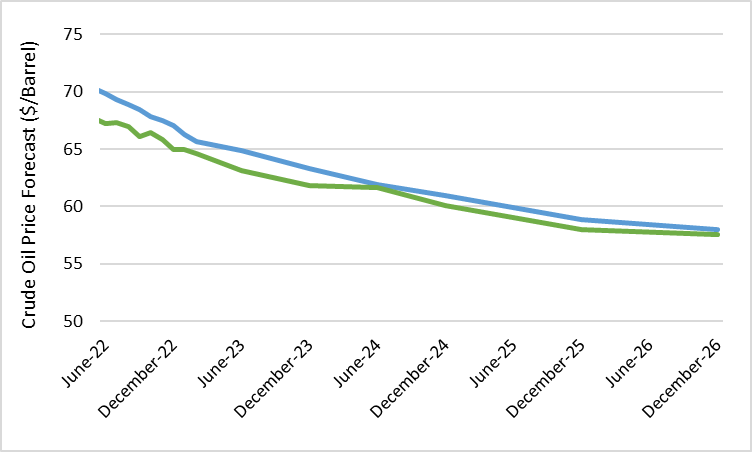 Figure 28. Crude oil futures
Data source: CME Group, Oil
One approach to forecasting oil prices for DER BCA inputs is to use the U.S. EIA STEO forecasts for the first year or two of the study period, and then use the AEO forecasts for the remaining years. Forecasts from futures markets can be used for intermediate years and can also be used as a benchmark to check the AEO forecasts (see CME Group, Oil).
The oil price forecasts tend to be provided for a variety of different fuel grades. DERs might affect different grades of oils depending upon the customer and sector they serve. In general, the following fuel grades can be used to determine oil supply impacts associated with DERs:
- No. 2 grade is distillate fuel oil used in the residential sector.
- No. 4 grade is distillate fuel oil used in the other sectors.
- No. 6 grade is residual fuel oil used in the commercial, industrial, and electric sectors. (See AESC 2021, page 56.)
Note that customers in different regions of the country might use different fuel grades than those presented here. Consequently, these might need to be modified for those regions.
Price Forecasts for Other Fuels
U.S. EIA provides a variety of price forecasts for other fuels. The same methods described above for oil price forecasts can be used to prepare price forecasts for other fuels. In sum, short-term U.S. EIA forecasts can be used for the early years of the study period; long-term U.S. EIA forecasts can be used for later years in the study period; and alternative forecasts can be used instead of or as a benchmark for short- to intermediate-term forecasts (see CME Group, Oil).
For some types of other fuels, the U.S. EIA or alternative forecasts might not extend out through the full BCA study period. In these cases, the longer-term oil price forecasts can be used as an index to extrapolate the other fuel prices.
5.2.1.c. Resources For Calculating Other Fuel Supply Impacts
Avoided Energy Supply Components Study Group. 2021. (AESC 2021). Avoided Energy Supply Components in New England: 2021 Report. Prepared by Synapse Energy Economics, Resource Insight, Les Demans Consulting, Northside Energy, Sustainable Energy Advantage.
CME Group. n.d. (CME Group, Oil). “Crude Oil Futures and Options.” cmegroup.com website. www.cmegroup.com/markets/energy/crude-oil/light-sweet-crude.quotes.html.
U.S. Energy Information Administration. 2021. (U.S. EIA AEO 2022). Annual Energy Outlook 2021. https://www.eia.gov/outlooks/aeo/
U.S. Energy Information Administration. Updated 2022. (U.S. EIA STEO). “Short-Term Energy Outlook.” eia.gov website. www.eia.gov/outlooks/steo/
5.3. Other Fuel Environmental Compliance Impacts
5.3.1.a. Definition
Overview of Other Fuel Environmental Compliance Impacts
Other fuel suppliers are sometimes required to incur costs for compliance with environmental requirements. Many such requirements are already included in other fuel prices impacts and therefore do not need to be calculated separately. GHG mandates are the primary environmental requirement that might need to be estimated separately for other fuels.
GHG mandates specify emission reductions relative to a benchmark amount (e.g., 1990 emissions) or sometimes place a cap on total emissions (as in cap-and-trade above). They sometimes limit emissions by a single target year (e.g., 2030), or sometimes limit emissions by increasing amounts for several target years (2030, 2040, 2050). Mandates are legally required, while targets are generally not legally binding. An example of a federal GHG target is the U.S. Nationally Determined Contribution, a 2030 emissions target submitted under the Paris Climate Agreement (See U.S. 2021 NDC).
Relationship to Societal Environmental Impacts
Societal environmental impacts are the impacts on the environment that occur in the absence of environmental requirements or after the environmental requirements have been met. It is important to distinguish between environmental compliance impacts and societal environmental impacts.12
- Environmental compliance impacts are the direct impacts in dollar terms that will be incurred by the utility and passed on to all customers through revenue requirements and customer rates.
- Societal environmental impacts are imposed on society as a whole but do not affect the cost of electricity services.
For further discussion see Section 3.2.6.
Anticipated Environmental Requirements
BCAs should account for all environmental requirements expected to be in effect over the study period, including those in place but not yet in effect, and those that are not in place but are likely to be in place during the study period.
A BCA should account for all environmental requirements expected to be in effect over the study period (See RAP 2012; RAP 2013, pages 32-37). This should include requirements that are already established by statutes, regulations, orders, or other directives, even if they have not taken effect yet. If a particular requirement is expected to take effect in three years, for example, then the implications of that anticipated requirement should be applied in the third year of the BCA study period and beyond.
Similarly, BCAs should also account for environmental requirements that have not yet been established but are reasonably likely to be established within the study period. Environmental regulations often become more stringent over time (see RAP 2013, page 29) and failure to account for such changes will understate the actual environmental compliance costs.
There may be situations where it is not entirely clear whether environmental requirements will be imposed on other fuels. For example, a state might establish a GHG target, but the target is not a binding mandate, or the target is applied to the entire economy and not explicitly applied to other fuels. In these situations, stakeholders and regulators should estimate the most likely timing and magnitude of the targets on other fuels using the best information available. To completely ignore the GHG targets will understate the costs of compliance with them in the BCA.
There will inevitably be some uncertainty about anticipated environmental regulations, just as there is uncertainty about most of the impacts discussed in this MTR handbook. Risk assessment techniques can be used to address this uncertainty.
In the case of other fuels, the cost of compliance with current GHG emission mandates, if any, are likely to be included in the current prices and price forecasts for these fuels. Thus, the anticipated environmental requirements might be the only environmental compliance costs that need to be accounted for in this case.
5.3.1.b. Method for Calculating Compliance with GHG Mandates
To calculate the cost for other fuels to comply with GHG mandates, it may not be practical or appropriate to use the planning constraints or the GHG cost methods described above for electric and gas utility systems (see Section 3.2.6.b).
Further, for other fuels the only form of environmental compliance costs might be the compliance costs associated with anticipated environmental requirements because current environmental requirements are typically accounted for in the cost of the other fuels. In these cases, the best option might be to start with a value for the societal GHG impact and modify it to reflect the anticipated GHG requirements.
For example, in a situation where a state is expected to apply an economy-wide cap on GHG emissions, which requires a 10 percent reduction in GHG emissions by 2025 and increasing reductions until zero GHG emissions is reached in 2050, then the value for the societal GHG impact can be applying starting in 2025. The GHG compliance cost value for 2025 could be set to a portion of the total societal GHG impact, and then increase commensurate with the reduction in the GHG cap until it reaches the full societal GHG value by 2050.
Methods for calculating the dollar value of the societal GHG impact are discussed in Section 7.1.2.
5.3.1.c. Resources for Calculating Other Fuel Environmental Compliance Impacts
Regulatory Assistance Project. 2012. (RAP 2012). Energy Efficiency Cost-Effectiveness Screening: How to Properly Account for ‘Other Program Impacts’ and Environmental Compliance Costs. T. Woolf et al., Synapse Energy Economics. www.synapse-energy.com/sites/default/files/SynapseReport.2012-11.RAP_.EE-Cost-Effectiveness-Screening.12-014.pdf.
Regulatory Assistance Project. 2013. (RAP 2013). Recognizing the Full Value of Energy Efficiency. J. Lazar and K. Colburn. https://www.raponline.org/wp-content/uploads/2016/05/rap-lazarcolburn-layercakepaper-2013-sept-09.pdf
Smart Electric Power Association. 2021. (SEPA 2021). “Utility Carbon-Reduction Tracker™” sepapower.org website. sepapower.org/utility-transformation-challenge/utility-carbon-reduction-tracker/
United States Government. 2021. (U.S. 2021 NDC). The United States of America Nationally Determined Contribution—Reducing Greenhouse Gases in the United States: A 2030 Emissions Target. www4.unfccc.int/sites/ndcstaging/PublishedDocuments/United%20States%20of%20America%20First/United%20States%20NDC%20April%2021%202021%20Final.pdf.
5.4. Other Fuel Wholesale Market Price Effects
5.4.1. Definition
Wholesale market prices are a function of the demand of buyers and the marginal costs of suppliers. When DERs reduce (or increase) the demand for other fuels, they reduce (or increase) the wholesale market prices, which creates benefits (or costs) for all customers participating in the wholesale market. Even a very small perturbation of the market price can have large impacts when applied across all wholesale customers. This effect is sometimes referred to as demand reduction induced price effect (DRIPE).
Unlike electricity, but like gas, wholesale market price effects for other fuels are expected to persist for the life of the DER (see AESC 2021, page 233).
Other fuel wholesale market effects are likely to be considerably lower than those for electricity and gas because the impact on consumption of other fuels from DERs is likely to be very small compared with the national or international markets for those fuels.
5.4.2. Method for Calculating Wholesale Market Price Effects
For other fuels, the wholesale market price effect can focus on the oil markets. This will provide a value that can be used for oil, which can then be adjusted for other types of other fuels.
The other fuel wholesale market price effects can be calculated with the steps shown in Table 53.
Table 53. Steps for calculating other fuel wholesale market price effects
| Step 1
|
Estimate the wholesale gas price elasticity
This is the “price shift,” which represents the change in gas price ($/MMBtu) for a change in gas demand (MMBtu). Oil play breakeven analyses can be used for this purpose. Oil play breakeven analysis “models the price at which a given geological formation is revenue neutral (a specific oil field or formation is known in the industry as a “play”). Different plays have different breakeven points, and when considered in aggregate, a supply curve can be made to show the prices at which various sources of new supply would enter the market. This curve can be thought of as analogous to an electric market’s power plant offer stack” (see AESC 2021, pages 230-231).
|
| Step 2
|
Express the price shifts in terms of price-per-demand (in $/MMBtu of demand)
They can then be applied to any generic change in demand. This can be achieved by multiplying the price elasticities by total future market demand. The price-per-demand value can then be multiplied by a DER’s anticipated savings to determine the wholesale market price effect.
|
| Step 3
|
Adjust the price-per-demand value
Adjust the value to account for market conditions that affect the magnitude of the wholesale market price effect.
|
5.4.3. Resources for Calculating Wholesale Market Price Effects
Avoided Energy Supply Components Study Group. 2021. (AESC 2021). Avoided Energy Supply Components in New England: 2021 Report. Prepared by Synapse Energy Economics, Resource Insight, Les Demans Consulting, Northside Energy, Sustainable Energy Advantage.
5.5. Delivery Impacts
Delivery costs for other fuels are typically included in the fuel prices. Therefore, they do not need to be calculated separately from the supply costs.
12 Societal environmental impacts are sometimes referred to as “environmental externalities.” They are also sometimes referred to as “non-embedded” environmental impacts (AESC 2021).