2.1. Overview
The NSPM for DERs (NSPM 2020) provides guidance on how to determine primary and secondary tests to use for BCAs. It provides a framework for determining what types of impacts should be included in BCAs per the fundamental NSPM BCA Principles, including consistency with a jurisdiction’s policy goals and objective (see NSPM 2020). Establishing a jurisdiction’s BCA test(s) is the first of many steps to assessing cost-effectiveness.
Once a jurisdiction has defined its BCA test and the impacts to be accounted for, there are multiple steps necessary to calculate the impacts to input in a BCA. Figure 1 summarizes the process for developing or quantifying the costs and benefits of DER investments. Each section in this chapter provides a brief discussion of each step in Figure 1. These steps are useful for understanding the descriptions of the methods that are provided in Chapter 3 through Chapter 10.
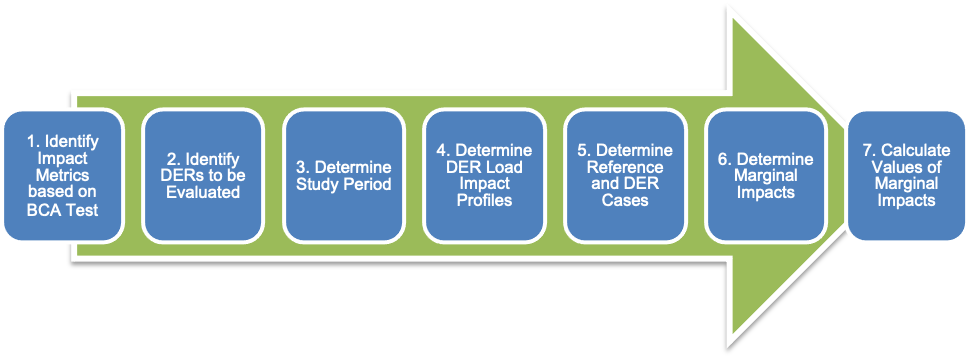 Figure 1. Key steps for calculating BCA values
2.2. Identify Impact Metrics
Once the impacts to be included in the BCA test are identified, then the metrics for estimating the impacts can be determined. For most impacts this is straightforward. For example, the metric for electric energy impacts is megawatt-hours (MWhs); the metric for electric capacity impacts is megawatts (MW); the metric for gas impacts is therms or million British thermal units (MMBtus); the metric for greenhouse gas (GHG) impacts is tons of GHG emissions. For some impacts the choice of metrics is less obvious. For example, estimates of reliability and resilience impacts might rely upon a variety of different metrics, such as system average interruption duration index, hours to restore service, and more (see Chapter 8).
These metrics can be applied to the marginal DER impacts to determine the dollar value of the impact. For example, the DER energy savings (in MWh) can be multiplied by the marginal energy impact (in $/MWh) to determine the monetary energy value (in $).
2.3. Identify the DERs to Be Evaluated
A key initial step is to identify the types of DERs to be analyzed in a BCA, i.e., whether energy efficiency, demand response, distributed generation, storage, electrification, electric vehicles, or some combination of these DERs. It is also important to initially establish the scale of the DERs to be analyzed, i.e., the approximate capacity (MW) and energy (MWh or MMBTU) of each DER type, in each year assessed.
The type and magnitude of DERs to be assessed will have important implications for determining DER load impact profiles (see Section 2.5), for determining the DER case (see Section 2.6), and for determining marginal impacts (see Section 2.7).
2.4. Determine the Study Period
The BCA study period is the number of years over which benefits and costs will be analyzed. The study period should be long enough to include the full operating life of the DERs being analyzed. This approach is necessary to account for all the benefits and costs of the DERs (see NSPM 2020, page 2-7).
For example:
- For a BCA of an energy efficiency plan that includes three years of energy efficiency installations, the study period should include the three years of the installations plus enough years to span the lifetime of the energy efficiency measures with the longest life. If the longest life is 20 years, then the study period should include at least 23 years to capture the full impacts of the energy efficiency measures installed in the third year.
- For a BCA of a one-year distributed solar photovoltaic (PV) program with a 25-year operating life, the study period should be 25 years. For a BCA of a 10-year distributed PV installation program, the study period should be 35 years to capture the full impacts of the PV installed in the 10th year of the program.
2.5. Determine DER Load Impact Profiles
Load impact profiles can vary widely for different DERs, and the value of the DER resource can vary over different seasons of the year, days of the week, hours of the day, and even within shorter periods of time.
The term “load impact profile” is used here to indicate a DER’s hours of operation as well as the magnitude of the energy and capacity impacts produced in those hours. Since load impact profiles can vary widely for different DERs and the value of the DER resource can vary over different seasons of the year, days of the week, hours of the day, and even within shorter periods of time, defining DER load impact profiles is often required to determine DER utility, host customer, and societal impacts.
For example, some energy efficiency resources might reduce customer demand consistently every hour of the year, while other energy efficiency resources might reduce demand only during peak periods of the day or year. As another example, the load impact profile for storage technologies might vary significantly depending upon whether they are controlled by the utility or the host customer, and, if the latter, depending upon the host customer’s rate design.
Combinations of multiple DER types might also lead to different load impact profiles than if they were installed separately. For example, a storage technology might have a very different load impact profile if it is paired with a distributed PV resource, because the customer might charge the storage resource when PV output exceeds onsite energy needs rather than charging it when energy prices are low. Similarly, the typical load impact profiles of electric vehicles added to the system will be very different if they are uncontrolled than if they are enrolled in a managed charging demand response program.
Some DER types are highly dispatchable while others are not. For example, distributed PV resources and many energy efficiency resources are not dispatchable, while storage and some demand response resources are highly dispatchable. Further, some DERs might be dispatched in response to customer interests while others might be dispatched to meet the short-term peak demands of the electricity grid.1
Ideally, DER load impact profiles would be developed on an hourly basis for each year of the BCA study period. Some DERs, such as distributed PV and storage resources, are likely to operate at very different levels throughout the day, which requires hourly information to capture the actual impacts at those different levels of operation. Other DERs, such as some energy efficiency and demand response resources, might not require hourly marginal impacts and load impact profiles; in which case it might be sufficient to use averages for key sub-annual periods, such as winter and summer or on- and off-peak periods.
Chapter 11 provides a detailed discussion of how to develop load impact profiles for different DER types and combinations of DER types.
2.6. Determine Reference and DER Case Assumptions
Understanding this construct of taking the difference between a Reference Case and DER Case scenario is foundational to many of the methodologies described in this handbook.
In general, BCAs require a comparison of two scenarios: one without the proposed DERs (the Reference Case)2 and one with the proposed DERs (the DER Case). The difference in the incremental costs and benefits between the two cases indicates the marginal impacts of the DERs included in the DER Case. Understanding this construct of taking the difference between two scenarios is foundational to many of the methodologies described in this MTR handbook.
In general, the Reference Case should be based on the most likely forecast of customer demand, except that it should not include the effects on customer demand of the DERs being evaluated in the BCA. This case should, however, account for the impacts of all DERs that have already been installed, and future DERs that are not being analyzed in the BCA. For example, a BCA that seeks only to determine the value of energy efficiency should include the expected impacts from electric vehicle and distributed solar adoption in the Reference Case load forecast.
In addition, it is important that the Reference Case properly account for all the DERs that might occur in the absence of the DER program, i.e., that might occur “naturally.” For example, for a BCA of a utility electric vehicle program:
- The Reference Case should include all the electric vehicles on the road at the time of evaluation plus all the electric vehicles expected to occur naturally.
- The DER Case should include all the electric vehicles in the Reference Case plus the incremental electric vehicles expected to be adopted as a result of the utility initiative.
This is illustrated in Figure 2 below, where a hypothetical utility electric vehicle program starting in 2023 is presented in the DER Case and compared with a Reference Case. The BCA for this electric vehicle program should capture the difference between the two cases. A BCA that used a Reference Case that included no new electric vehicles after 2023 would significantly overstate the impact of the utility electric vehicle program.
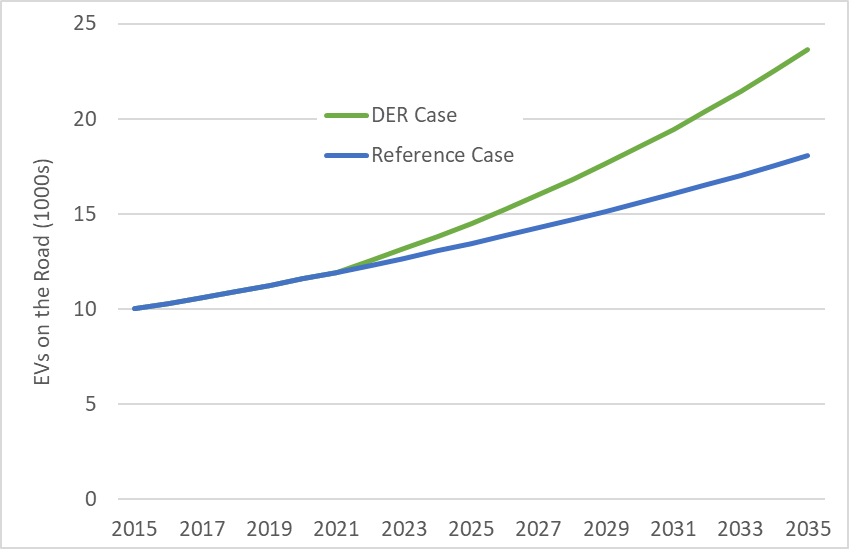 Figure 2. Illustration of reference and DER cases: utility electric vehicles program
Regardless of the amount of DERs assumed in the Reference and the DER Cases, all the supply-side resources included in each case should ideally be optimized to reduce system costs, while meeting applicable reliability, dispatch or construction constraints. Otherwise, the comparison between the two cases could be misleading. For example, in a DER Case, centralized power plants should be dispatched economically in light of the new load patterns created by the DERs being evaluated. In addition, the resources that can be deferred or avoided by the DERs (generation, transmission, and distribution resources) should be deferred or avoided to reflect that impact of the proposed DERs.
Example: California utilities use an Avoided Cost Calculator to determine the benefits associated with DERs. The Avoided Cost Calculator compares two scenarios that are prepared as part of the utilities’ integrated resource plan (IRP) processes. The No DER scenario assumes that no new DERs are installed in the future (i.e., the Reference Case) and the other scenario includes the level of DERs assumed to be installed in the future (i.e., the DER Case). The difference between these two cases provides the avoided costs of the DERs. (See CPUC 2020, pages 4-5.)
Note: The California Avoided Cost Calculator is set up to be applicable to many types of DERs. Therefore, the outputs from the calculator will not necessarily be tailored to the exact profile of any one DER type.
There are some circumstances where it is unnecessary to prepare two separate cases. For example, if only wholesale market prices are used to determine electric energy or capacity impacts, the market prices themselves represent marginal impacts and therefore there is no need to take the difference between two cases to determine what is marginal, i.e., incremental to a Reference Case. In this case, it is nonetheless necessary to determine which DERs to include in the electricity system when forecasting the wholesale market prices because the electricity load will affect the energy and capacity wholesale market prices.
Example: The 2021 AESC Study uses a forecast of wholesale energy and capacity prices to determine electricity generation and capacity impacts, and therefore does not take a difference between two cases. This study does, however, create several market forecasts (i.e., counterfactual scenarios) to identify the marginal costs under different scenarios of DER development. Each counterfactual scenario excludes the DER type that is being evaluated. In this way, each counterfactual indicates what the wholesale prices (i.e., marginal costs) would be in the absence of the DERs being evaluated. (See AESC 2021, pages 69-70.)
2.7. Determine Marginal Impacts
Marginal impacts represent the changes that would occur to utility systems, host customers, and society if the proposed DERs were to be implemented. Marginal impacts are one of the core elements of any BCA and it is important that they be properly defined and calculated. This section describes the rationale for using marginal (versus average) impacts, and for using long-run (versus short-run) marginal impacts.
2.7.1. Marginal Versus Average Impacts
When conducting BCAs, marginal impacts are appropriate to use rather than average impacts.
When conducting BCAs, marginal impacts are appropriate to use rather than average impacts. Marginal impacts are explicitly designed to capture the effects of adding DERs or other resources onto the electricity or gas system, such as the avoided cost of not having to produce an incremental unit of energy. Average impacts, on the other hand, blend the impacts of the DERs in with the costs of serving the rest of energy demand, and thus do not isolate the change in costs created by the DERs.
Marginal and average impacts are defined as:
- Average impacts – the cost of producing a product divided by the number of products produced.
- Marginal impacts – the change in per-unit costs as the result of a small change in output.
For electric and gas utilities, average and marginal impacts are generally calculated as shown in Table 2.3 In practice, however, many impacts are lumpy, rather than following a smooth, continuous function. Capacity costs, in particular, may be zero (or negative) when there is surplus capacity but then skyrocket when there is a shortage. For this reason, marginal impacts are sometimes calculated over larger increments of output (e.g., 50 MW), and then presented as unit costs (e.g., $/kW).
Table 2. Calculating average and marginal impacts for electric and gas utilities
| |
Average impacts |
Marginal impacts |
| Annual electric energy cost ($/MWh) |
total variable energy costs (in $) / total energy production (in MWh) |
change in the annual energy costs (in $) as the result of a small change in energy demand (e.g., one kWh) |
| Annual electric generating capacity cost ($/kW-year) |
total generation capacity cost (in $) / total capacity provided (in kW-year) |
change in annual capacity costs (in $) as the result of a small change in peak demand (e.g., one kW) |
| Annual gas production cost ($/MMBtu) |
total gas cost (in $) / total annual gas production (in MMBtu) |
change in annual gas costs (in $/MMBtu) as the result of a small change in gas demand (e.g., one MMBtu) |
Both average and marginal impacts can be calculated for different time periods, e.g., hours, days, months, seasons, years.
2.7.2. Long-Run Versus Short-Run Marginal Impacts
When conducting BCAs, long-run marginal impacts are appropriate to use rather than short-run marginal impacts.
When conducting BCAs, long-run marginal impacts are appropriate to use rather than short-run marginal impacts. This is necessary to ensure the analyses properly account for all benefits and costs experienced over the study period, which typically lasts 20 years or more. Using short-run marginal impacts will significantly understate the potential impacts of DERs.
Short-run costs are defined as the costs that occur before capital investments are made to increase production capacity. For electric and gas utilities:
- Short-run marginal electricity costs include those costs, such as fuel, operations and maintenance (O&M), and labor costs, that are incurred to produce electricity without requiring additional investments in new generation, transmission, or distribution capacity.
- Short-run marginal gas costs included include those costs, such as fuel, O&M, and labor costs, that are incurred to produce gas without requiring additional investments in new capacity for production, transportation, or delivery of gas.
Long-run costs treat all costs as essentially variable, including capital costs. These include short-run costs as well as capital investments to increase production capacity. Long-run costs should include all costs incurred over the full BCA study period. For electric and gas utilities:
- Long-run marginal electricity costs include all short-run marginal impacts plus the costs associated with new generation, transmission, and distribution capacity investments. Long-run costs should also account for any reductions in capacity, such as the retirement of existing generation, transmission, and distribution facilities.
- Long-run marginal gas costs include all short-run marginal impacts plus the costs associated with new capacity for production, transportation, or delivery. Long-run costs should also account for any reductions in capacity, such as the retirement of existing production, transportation, and delivery facilities
In sum, short-run costs assume there are no new capital investments or new production capacity, whereas long-run costs assume new production capacity and include the costs associated with that new capacity. Therefore, it is important to use long-run marginal impacts in BCAs for DERs, because DERs can potentially postpone or avoid capacity costs that are not included in short-run costs.
2.7.3. Timing and Magnitude of Marginal Impacts
Marginal impacts are based on a change in the amount of electricity or gas production as a result of the proposed DER. The timing and magnitude of DER impacts can significantly affect the marginal cost. For example:
- A one MW change in demand during a peak hour of the year would result in higher marginal impacts than would a one MW change in demand during an off-peak hour of the year.
- A one MW change in demand for each hour of the year would result in different marginal impacts than would a one GW change for each hour of the year.
A DER Case should include a forecast of the magnitude of proposed DERs to be implemented in each year and should ideally account for the hourly load impact profile of the proposed DERs throughout each year (see Chapter 11). For example:
- For an efficiency program that reduces refrigeration demand consistently by 5 MW each hour of the year, the DER Case should reflect a 5 MW reduction in demand for each hour of the year, for each year when the efficiency measures operate.
- For a demand response program that reduces peak demand by 20 MW each month, the DER Case should reflect a 20 MW reduction in peak demand each month, for each year the program operates.
- For a distributed generation compensation mechanism that encourages residential distributed PV resources, the DER Case should reflect a reduction in demand for each hour the PV resources are expected to operate each day of the year, for each year the distributed PV resources operate.
- For a distributed storage program, the DER case should reflect the hourly increases and decreases in demand caused by the storage technology, for the years that the storage technology operates. For some storage resources that are expected to provide ancillary services or be used for sub-hourly energy arbitrage, it would be better to reflect sub-hourly changes in demand.
- For a building electrification program, the DER Case should reflect the hourly increased energy and peak demands caused by the new electric end-uses, for each year the installed technologies operate.
- For an electric vehicle charger installation program, the DER Case should reflect the projected hourly electric vehicle charging patterns, for each year the chargers operate. If the electric vehicles will be charging according to time-of-use rates, then the DER Case should assume electric vehicle charging patterns consistent with those rates.
The exact approach used to calculate the marginal impacts on the utility system from the proposed DER might have relatively small implications when small amounts of DERs are expected to be installed, because small amounts of load reduction might not significantly change the marginal resources on the system. When large amounts of DERs are expected to be installed (relative to the total resources on the system), however, then the assumptions made about marginal changes to the system can have significant implications for the results of the BCA.
2.8. Calculate the Dollar Value of Marginal Impacts
The dollar value of an impact is determined by multiplying the relevant metric (e.g., MWh, kW, MMBtu, ton of pollutant) by the marginal cost (e.g., $/MWh, $/kW, $/MMBtu, $/ton of pollutant). The marginal impacts should be “mapped onto” the DER load impact profile, i.e., the marginal impacts should be based on the same time period when the DER is operating (hour, day, week, month, season, or year, depending upon the DER and data available).
Figure 3 illustrates how hourly marginal impacts should be mapped onto the hourly DER load impact profile. This example is for a distributed PV resource. The PV load impact profile is indicated by the blue line, while the marginal energy cost is indicated by the green line. Both the marginal cost and the energy generation vary throughout the day. In order to properly calculate the dollar value of the PV generation, the hourly marginal costs should ideally be multiplied by the hourly energy generation, for each hour of the day.
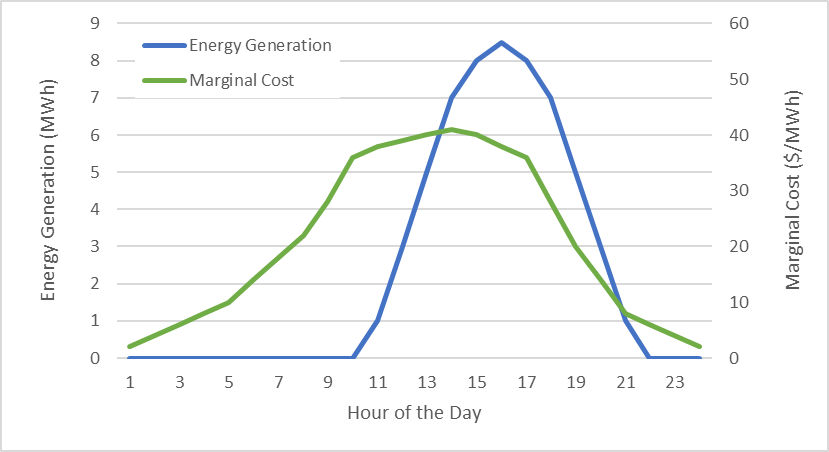 Figure 3. Illustration of mapping marginal impacts onto DER load impact profile
Note: Values are meant to be illustrative and do not represent an actual PV project or actual marginal cost
2.9. Summary
A summary of the key steps to calculating BCA impacts is provided below. Many of these (or similar) steps are used in the methods described throughout this MTR handbook. (Note that the steps listed below are not exactly the same as those listed in Figure 1 because it is not necessary to go through all of those steps for each of the impacts.)
Table 3. Key steps to calculate BCA impacts of DERs
| Step 1 |
Identify Impacts Metrics based on BCA Test:
Once the relevant impacts for the BCA test are identified (see NSPM 2020), these impacts will define the relevant metrics to use in estimating the value of marginal impacts, e.g., MWh, kW, MMBtu, others. (See Section 2.2. and Table 4.) |
| Step 2 |
Identify DERs to be Evaluated:
The types of DERs to be analyzed in a BCA may include energy efficiency, demand response, distributed generation, storage, electrification, electric vehicles, or some combination of these DERs. Establish the scale of each DER to be analyzed, i.e., approximate capacity (MW) and energy (MWh or MMBTU), in each year assessed. (See Section 2.3) |
| Step 3 |
Determine the Study Period:
The BCA study period is the number of years over which benefits and costs will be analyzed. The study period should be long enough to include the full operating life of the DERs being analyzed (See Section 2.4). |
| Step 4 |
Determine DER Load Impact Profiles:
The DER load impact profiles can be used to estimate the energy and capacity impacts of the proposed DER, i.e., the magnitude and timing of MWh, kW, MMBtu, or other impacts. (See Section 2.5.). |
| Step 5 |
Determine Reference and DER Use Cases:
The Reference Case creates a baseline against which the DERs will be compared. The DER Case should include all the incremental DERs being evaluated in the BCA and should not include all the other resources avoided by those DERs. (See Section 2.6.) |
| Step 6 |
Determine Marginal Impacts:
The marginal impact can be calculated as the difference between the value of the relevant metric(s) for the DER Case minus the value of the relevant metric(s) for the Reference Case. (See Section 2.7.) |
| Step 7 |
Calculate Values of Marginal Impacts:
The dollar value is determined by multiplying the relevant metric by the marginal impact. The marginal impacts should be “mapped onto” the DER load impact profile. (See Section 2.8.) |
Using the above steps, Table 4 provides examples for some key DER impacts.
Table 4. Overall structure for calculating the value of several DER impacts
| Step |
Calculation |
Electric Energy |
Electric Capacity |
Gas Energy |
Reliability |
| 1. Identify Impact Metric(s) |
Determine based upon type of impact |
MWh |
kW |
MMBtu |
SAIDI & SAIFI |
| 2. Determine DER Load Impact Profiles |
Determine based upon DER type and use case |
MWh |
kW |
MMBtu |
kW, MMBtu |
| 3. Develop Reference Case |
Calculate the magnitude and value of relevant metrics |
$ and MWh |
$ and kW |
$ and MMBtu |
$ and hours of outage time |
| 4. Develop DER Case |
Calculate the magnitude and value of relevant metrics |
$ and MWh |
$ and kW |
$ and MMBtu |
$ and hours of outage time |
| 5. Determine Marginal Impact |
Calculate the difference between DER and Reference Cases |
$/MWh |
$/kW |
$/MMBtu |
$/hour |
| 6. Calculate Dollar Values |
Map marginal impact onto load impact profile |
$ |
$ |
$ |
$ |
For Step 5, the per-unit costs (in $/MWh, $/kW, $/MMBtu, and $/hour) are calculated by dividing the difference in cost (in $) by the difference in the metric (MWh, kW, MMBtu, or hour), where the differences are equal to the values from the DER Case (from Step 4) minus the values of the Reference Case (from Step 3).
Not all impacts/metrics need to be calculated using the above structure. In some cases, the marginal impact can be determined without a full analysis and comparison of a Reference and a DER Case. Table 5 provides some examples of simpler calculations for Other Fuel and GHG emission impacts, where existing data is used to calculate the marginal impact.
Table 5. Simpler structure for calculating the value of some impacts
| Step |
Calculation |
Other Fuels (e.g., oil) |
GHG Emissions |
| 1. Define Relevant Metric(s) |
Determine based upon type of impact |
barrels |
tons of GHG, MWh |
| 2. Identify Load Impact Profiles |
Determine based upon DER type and use case |
barrels |
MWh |
| 3. Develop Reference Case |
Calculate the magnitude and value of relevant metrics |
not necessary |
not necessary |
| 4. Develop DER Case |
Calculate the magnitude and value of relevant metrics |
not necessary |
not necessary |
| 5. Calculate Marginal Impact |
Difference between DER and Reference Cases |
oil price represents the marginal impact ($/barrel) |
use publicly available marginal GHG emission rates ($/MWh) |
| 6. Calculate Dollar Value |
Map marginal impact onto load impact profile |
$ |
$ |
Some impacts can be calculated with methods that are even simpler than this. For example, DER program administration costs include only the incremental administration costs associated with the program. In this example, the metrics are in dollars, the load impact profile is not relevant, and there is no need to conduct a full-blown analysis of all the utility program costs in a Reference Case or the DER Case. All that is needed is an estimate of the incremental administration costs of the program.
1 Ideally, rate design elements such as demand charges and time-of-use rates should be structured to encourage customers to operate their DERs in a way that would address the short-term peak demands on the electricity grid. In such cases, there would be no difference in the DER load impact profile. In practice, however, it is often the case that rate designs do not exactly reflect the short-term peak demands on the electricity grid, which would result in different load impact profiles depending upon who controls and operates the DER.
2 The Reference Case is sometimes referred to as a Business-as-Usual Case or a Baseline Case. This handbook uses the term “Reference Case” because it more generically refers to a case that is designed to be compared with a DER Case.
3 This chart includes three example calculations, one for each of the three main metrics used in BCAs: $/MWh, $/kW-year, and $/MMBtu.